
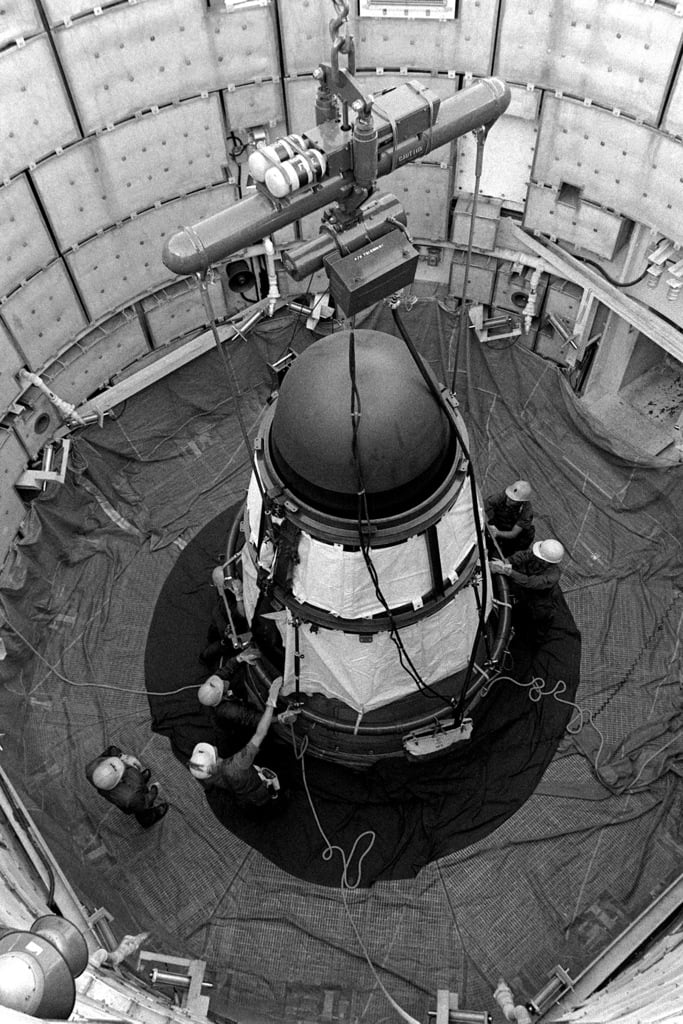
I listened carefully as the Missile Combat Crew Commander recited his name and rank into the red phone, one of a hundred MCCCs that I knew were doing that right then across the country. The call had come with an alarm throughout the bunker, which summoned the four on-shift workers to this room. I watched the Control Monitor Group display as the fuel percentage ticked up more and more.
The MCCC was standing at the edge of the room at the red phone, listening to what I could only assume was the launch codes being recited. The Deputy MCCC was with us, ensuring the targeting and all systems were prepared for launch. We all knew Protocol Red-76-A by now, it was a preset in the launch computer. Half our test runs had been based on this protocol. And now, as it was activated, we all knew exactly where we were aiming. The center of Moscow.
—
The room was basked in a red light as alarms blared through the hallway. Protocol White-50-A32 had been activated, and each of the three officers in this room knew exactly what that meant. In some manner, the United States had attacked or offended us enough that our only option was to end them as quickly as possible.
Our station had two missiles, each aimed to the same spot and programmed to take a different path. A binder on my desk held the coordinates for every protocol possible, with White-50-A32 right at the top. As I read the programming aloud, another officer typed it into the computer, which would write it onto two drives it was our responsibility to insert into the onboard computer before the launch.
Once the two drives were ready, the other officer and I looked each other directly in the eyes. If we continued, we would be partially responsible for the destruction of a global superpower. Our missiles would be essential in taking down the United States. Our missiles would hit the dead center of DC.
—
The MCCC and DMCCC were at the front of the room to turn the launch keys, and the Missile Facilities Technician was standing just behind them, watching the various displays as they did so. It was almost impossible that any of us would ever experience this again. As the missile launched, I stood at the window, watching the smoke and flame of the engine power up.
And at that moment, we were done. Every single action that would be taken from this point on was done by an onboard computer with the missile, aiming it for the heart of the iron curtain. And now, we got to experience the greatest benefit of this job, the nuclear bunker.
—
As I slotted my drive into the on-board computer, I could hear the countdown echo through the speakers that lined the walls of the silo. I quickly closed the drive slot and rushed back to the door, where ten officers of my rank were waiting. As the missiles both launched on the other side of the door, we began to party.
The bunker we sat in was completely submerged under the dirt, with ten stories. The bottom four were closed off with us inside them, as an extra precaution in case the area was hit by a retaliatory missile by an opponent, and consisted of everything we’d need to survive until we could be evacuated. This included, of course, the supplies for a party.
—
The 12 officers who lived in this bunker gathered in the dining room as the alarms cut off, the room buzzing with excitement. In the corner, a small television rattled the news to itself. Each of us had a glass of wine in our hands, and were chattering to each other about what we thought was going to happen now that the soviets were dead.
Across the room from me, a DMCCC mentioned the nukes that the soviets had by no doubt launched at us first. According to the broadcast on the television, nobody knew when the first would hit, but we all knew that wasn’t true.
Next to the television, a radio sat silently. It was tuned to a frequency which would receive bomb alerts telling us when to be in stable positions. None of us had addressed it, but we all knew listening to the radio would be pointless. The bombs would hit when they hit, and we might fall or break some glass when they do, but this bunker was on the forefront of nuclear security. The engineers had built it to withstand an accidental detonation of the warhead we lived beside, there was no way it couldn’t take a hit from outside.
—
Just before the first American missiles hit Moscow, the six officers stationed in this bunker were all beginning to get tipsy. The rattling echoed through the bunker walls, and as a bottle of vodka fell from the counter and shattered on the floor, the room fell silent.
We had all read papers that told of an anti-missile system that was being used in civilian areas. The details had been hidden from spies but we knew that the system was real. There was no chance that a missile would have hit Moscow. And yet, the radio warning of the strikes fell silent.
—
As the news reported bombs hitting Sacramento, then Houston, then DC, then New York, the room in the bunker got quieter and quieter. Part of Protocol Red-76-A was supposed to be counter-nukes hitting their silos before they could respond. But as missile after missile hit civillian after civillian, we all knew that the next hits were going to be bunkers.
We sat silently, our wine set on counters and tables. Nobody was drinking. Each of us had a family somewhere close to the bunker, someone we could visit on the holidays. And as the radio reported strikes hitting bunker after bunker, we all listened carefully.
The first strike that hit us rattled the basement. Another BMAT fell of the counter with a couple wine glasses, and just lay there on the ground. As the radio rattled off our callsign, I breathed a sigh of relief. And as I set my back against the wall, the second strike burned through my skin.
This story was originally published as part of a then-weekly writing event called Frights By Fire, which is hosted by Athan and Jamie of Hush Studios, creators of [REDACTED], The Cellar Letters, and The Grotto, three great audio dramas. The theme for this week was Celebration, which had me thinking about something people would like that wasn’t very good. I did as much research as I could into how nuclear missiles would have worked during the cold war, but it was harder to find the kind of information I really wanted from the USSR. Other than possible inaccuracy, I think it turned out pretty well.

